

You know that moment. You are standing in front of a room, about to give a presentation you have practiced a dozen times. Your heart starts pounding. Your palms get sweaty. Your mind goes completely blank. You freeze.

This experience of "choking" under pressure is far more common than most people realize.
That tight feeling in your chest is not weakness. It has a name. It is called performance anxiety. And the truth is, many people suffer through it silently, thinking something is wrong with them. They avoid speaking up or taking chances just to avoid that awful feeling. But here is the good news. Performance anxiety is something you can understand, manage, and overcome. You do not have to let it hold you back.
This guide will help you do exactly that. We will start by clearly defining what performance anxiety is and what it is not. Then we will walk through the symptoms and the cycle that keeps it going. Finally, we will share simple, evidence-based strategies to help you handle it in the moment and long term.
If you have ever felt that wave of panic before a big moment, you are not alone. Learning how to stop overthinking anxiety is the first step. Simple grounding techniques for anxiety can help you stay present when your mind wants to race. And developing coping skills therapy methods on your own can build your confidence over time.
But before we get into the techniques, let us name the pressure behind the feeling. When you understand what is really happening in your body and brain, the fear starts to shrink. That is where real change begins.
To start decoding those anxious feelings, explore how stress shows up in your body and get research-backed insights at Decode Anxious Feelings.
Let us begin by looking at the common symptoms and triggers.
What Is Performance Anxiety?
Performance anxiety is more than just being nervous. It is a specific type of anxiety that shows up when you are about to do something where other people might judge or evaluate you. Think of it as the brain and body sending a false alarm. Your system thinks you are in danger, even when the real risk is just embarrassment or failure.
According to medical research, performance anxiety is characterized by intense feelings of emotional distress before, during, or after performing in front of others. The fear is not about the task itself. It is about being watched, judged, or expected to succeed.
How Is It Different from General Anxiety?
General anxiety is a broad feeling of worry that can happen anytime, anywhere, even when you are alone on your couch. Performance anxiety only appears in specific situations where you have to perform. It is a focused kind of fear.
The key difference comes down to context. The differences between social anxiety and performance anxiety explain that performance anxiety is considered a subtype of social anxiety.
But there is an important distinction. People with general social anxiety feel uncomfortable in most social settings. People with performance-only anxiety do fine at parties or chatting with coworkers. They only struggle when they are the center of attention during a performance moment.
Where Performance Anxiety Shows Up
The trigger situations are more common than you might think. Here are the classic examples:
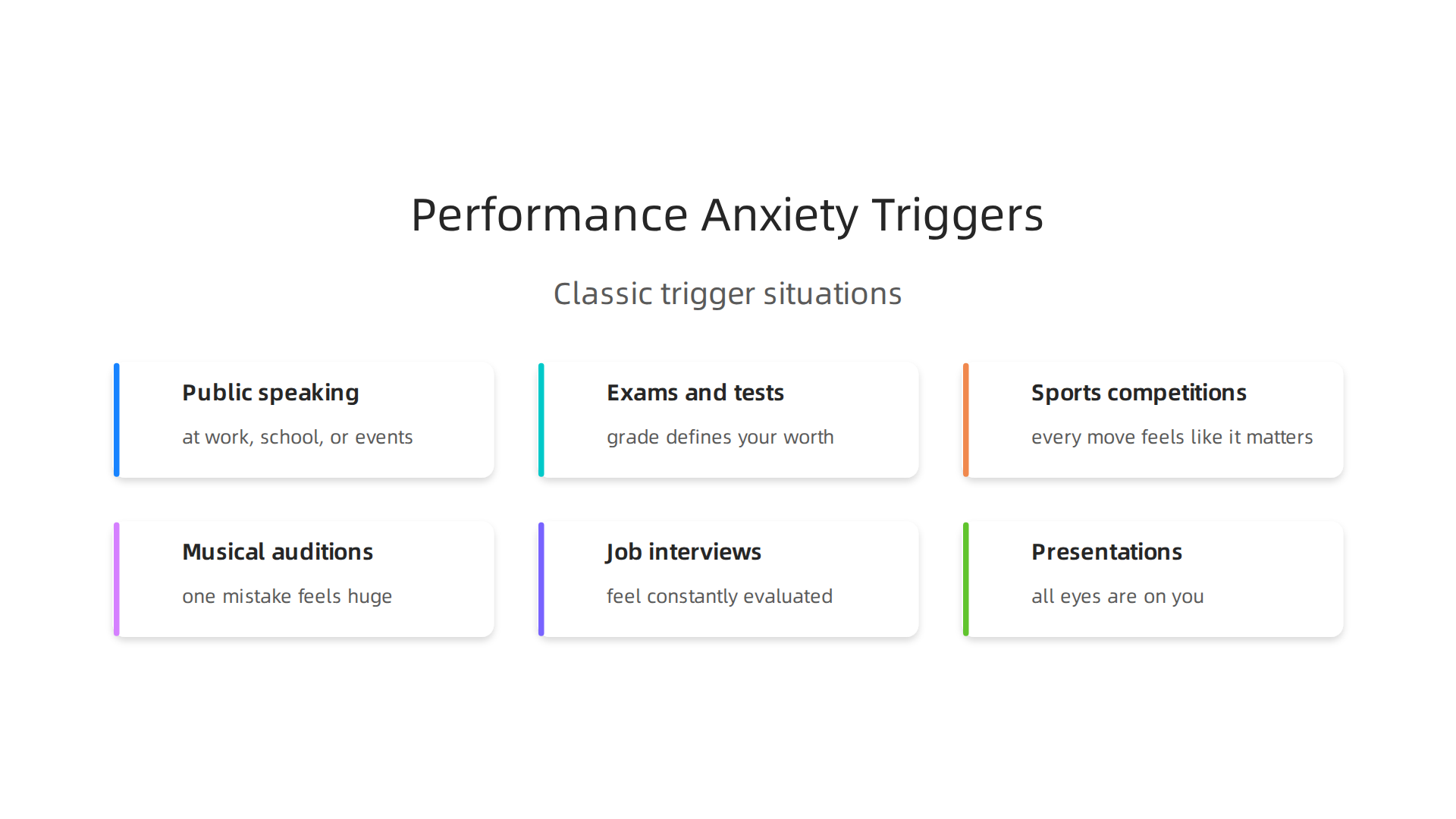
- Public speaking at work, school, or events
- Exams and tests where you feel your grade defines your worth
- Sports competitions where every move feels like it matters
- Musical auditions or performances where one mistake feels huge
- Job interviews where you feel constantly evaluated
- Presentations where all eyes are on you
You can find a more detailed list of performance anxiety signs and symptoms that covers how these situations trigger physical and mental distress.
What Causes the Reaction
Performance anxiety often comes from a gap between what the situation demands and what you believe you can handle. Your brain interprets the pressure as a threat. This activates the stress response. Your heart races. Your mouth goes dry. Your thoughts get scrambled.
The fear of failure, rejection, or embarrassment feeds the cycle. You start to focus on what could go wrong instead of what you know how to do. And the more you focus on the fear, the louder it gets.
If this sounds familiar, do not worry. You are not broken. Your brain is just trying to protect you from something it thinks is dangerous. Once you understand that, you can start to work with it instead of against it.
The next step is learning what this looks like in your daily life and how to break the pattern. For a deeper look into how your body processes anxious moments, you can use a research lens for anxious thoughts to understand what is really going on beneath the surface.
Let us walk through the most common symptoms next.
Common Triggers and Symptoms
Performance anxiety does not look the same for everyone. But the patterns are very predictable. Your body, mind, and behavior all react in specific ways. Once you know what these signs look like, you can catch them early and stop the cycle before it takes over.
Physical Symptoms
Your body reacts first. The moment you step into a triggering situation, your nervous system hits the gas. According to the Cleveland Clinic, performance anxiety symptoms include a racing heart, shaking or trembling, sweating, nausea or stomach discomfort, shortness of breath, dry mouth, muscle tension, and even dizziness.

Some people feel frozen, like they cannot move or speak.
These symptoms happen because your body releases adrenaline. It thinks you are in danger. But the danger is not real. It is just a presentation, a test, or a conversation. Your body is preparing for a threat that does not exist.
Cognitive Symptoms
Your mind joins the fight next. Racing thoughts, trouble concentrating, and imagining the worst-case scenario are all common. You might blank out completely. One minute you know your material. The next minute your mind is empty.
Performance anxiety also feeds catastrophic thinking. You start believing that one mistake will ruin everything. You replay failures in your head before anything even happens. This harsh self-talk after the event is also part of the pattern. If you want a deeper look at what these mental symptoms feel like, the guide on what anxiety feels like breaks it down in plain language.
Behavioral Symptoms
What you do matters just as much as what you feel. People with performance anxiety often avoid the situations that trigger them. They turn down speaking invites.

They skip auditions. They procrastinate on preparing because the pressure feels too heavy.
When they cannot avoid the situation, they might fidget, stutter, or leave early. Some people overprepare obsessively and still feel unready. Others rely on alcohol, substances, or unhealthy habits just to get through the moment. These coping methods may offer short relief, but they usually make the anxiety worse in the long run.
Common Triggers
The triggers are everywhere. Public speaking tops the list. Exams and tests follow closely. Job interviews, work meetings, sports competitions, musical performances, and social events where all eyes are on you can all set off performance anxiety.
The common thread is the feeling of being watched and judged. Your brain interprets that attention as a threat. That is when the symptoms start.
Recognizing these patterns is the first real step. When you know what is happening, you can stop blaming yourself and start using tools that actually work. One approach that has gained attention for helping people offset anxiety and depression involves shaping and rewarding healthy behaviors. As Authority Magazine highlighted, building new patterns through positive reinforcement can make a real difference.
Let us look at practical strategies you can use the next time performance anxiety shows up.
The Performance Anxiety Cycle
Here is the thing about performance anxiety. It does not just happen and then stop. It follows a loop. A very predictable one. And once you see the loop clearly, you can also see exactly where to step off.
How the Cycle Works
It starts with a trigger. A presentation. A test. An important conversation. That trigger fires a thought.
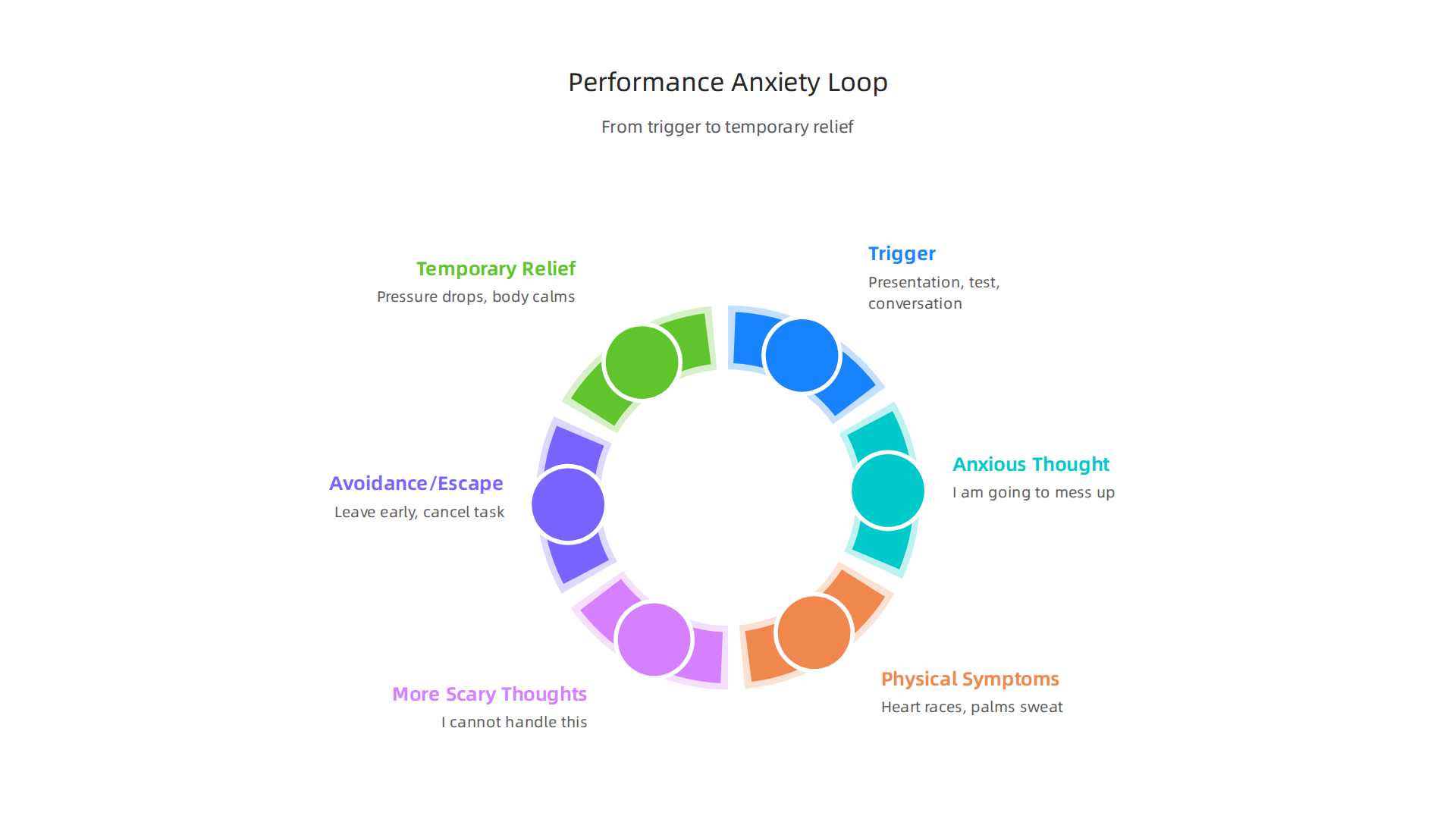
Usually something like "I am going to mess this up" or "Everyone is watching me." That thought activates physical symptoms. Your heart races. Your palms sweat. Your throat tightens.
Then comes the hardest part of the loop. Those symptoms feed more scary thoughts. You start thinking "See, my heart is pounding. Something is wrong. I cannot handle this." This spiral is what clinicians call a self-perpetuating pattern. As the experts at Therapy Group DC explain, the anxiety cycle often creates an exhausting loop where worried thoughts trigger physical symptoms, which fuel more catastrophic thinking, making things worse fast.
The next step is avoidance or escape. You leave early. You cancel. You rush through the task just to get it over with. And in that moment, you feel relief. The pressure drops. Your body calms down.
But here is the trap. That relief teaches your brain that the only way to feel safe is to avoid the trigger. So next time, the fear comes back stronger. The cycle repeats. And each time, the loop tightens.
Cognitive Distortions That Fuel the Cycle
Your thoughts are not always telling you the truth. Three common thinking traps make the cycle worse.
Catastrophizing. This is when your brain jumps straight to the worst outcome. One small stumble means the whole presentation is ruined. One mistake means everyone thinks you are incompetent.
Mind reading. You assume you know what others are thinking. You believe they are judging you harshly. But you cannot actually read minds. You are guessing. And your guesses are usually wrong.
Overgeneralization. One bad experience becomes proof that you will always fail. You gave one awkward speech. Now you believe you are terrible at public speaking forever.
These distortions are not your fault. They are patterns your brain learned. And as noted in the research on performance anxiety, these negative thought patterns contribute directly to the cycle of fear and reduce self-confidence.
How the Cycle Escalates Without Help
The longer the cycle runs, the worse it gets. Avoidance shrinks your world. You stop taking opportunities. You say no to things you actually want to do. The avoidance itself becomes a source of shame, which adds another layer of anxiety on top of the original fear.
The physical symptoms also get more sensitive over time. Your body learns to react faster and harder to smaller triggers. What started as mild nerves before a big speech can turn into a full panic response just thinking about a team meeting.
The good news is this cycle can be broken. It takes awareness first, then practice. If you want practical steps to interrupt these patterns, the guide on anxiety management step by step strategies that really work walks you through exactly how to start.
Let us look at tools you can use the moment the cycle tries to start.
Evidence-Based Strategies to Manage Performance Anxiety
The good news is you already have access to tools that work. Research shows that simple, repeatable techniques can calm your nervous system, change your thought patterns, and build real confidence over time. Let us walk through three strategies that are backed by science and easy to practice anywhere.
Breathing and Grounding Techniques
When the anxiety cycle starts, your body is in fight-or-flight mode. Breathing techniques are the fastest way to tell your body it is safe. One of the most effective methods is the 4-7-8 breath. You inhale quietly through your nose for 4 counts, hold for 7 counts, and exhale through your mouth for 8 counts. This pattern activates your parasympathetic nervous system and lowers your heart rate within a few breaths.
Another powerful tool is the 5-4-3-2-1 grounding technique. It pulls your mind away from scary thoughts and back into the present moment. Here is how it works:
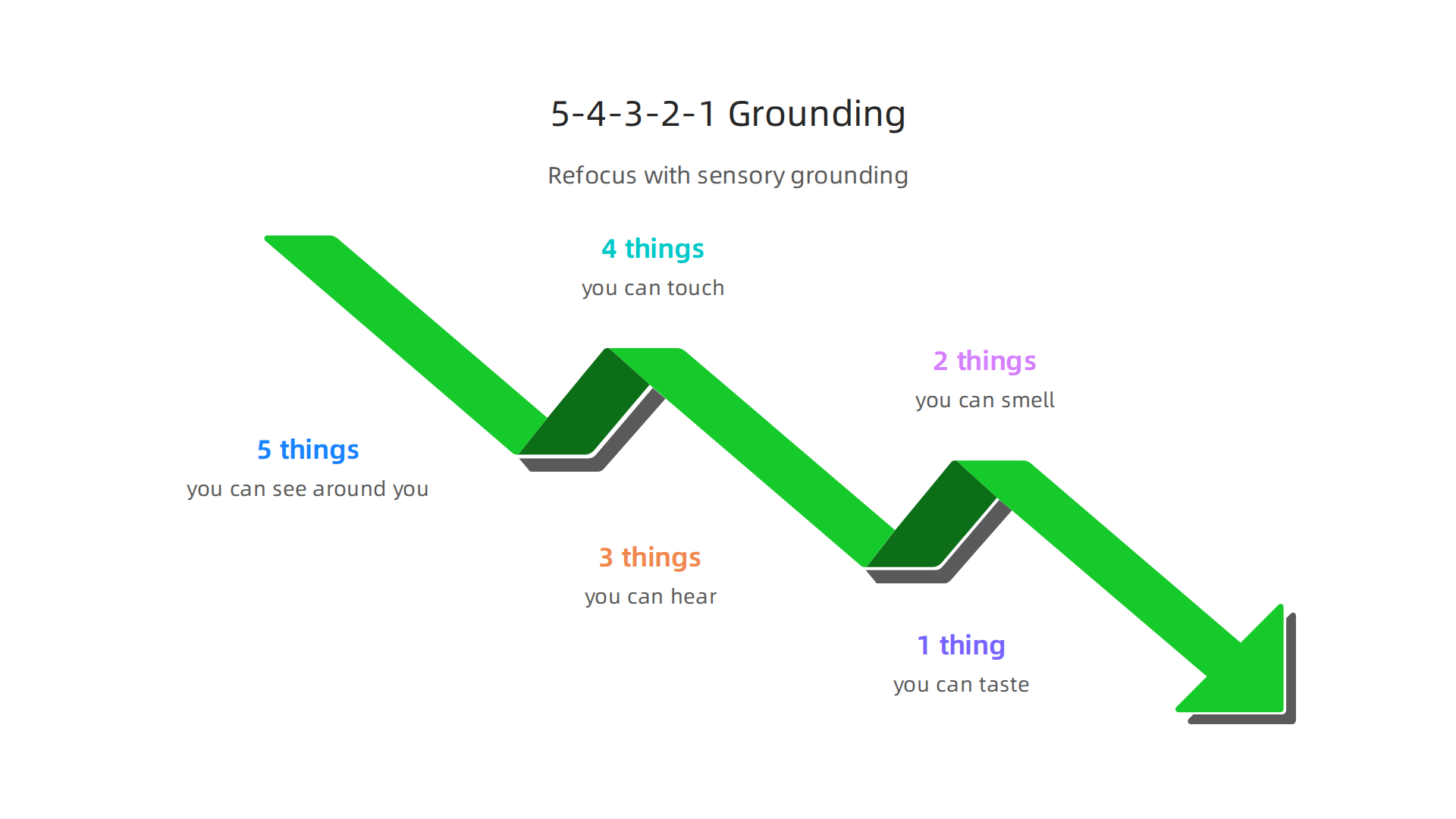
- 5 things you can see around you
- 4 things you can touch
- 3 things you can hear
- 2 things you can smell
- 1 thing you can taste
Experts note that these kinds of grounding strategies help you redirect attention from anxious thoughts to physical sensations, which interrupts the loop. The detailed guide on evidence-based breathing and grounding exercises walks you through each technique step by step.
Cognitive Reframing
Your thoughts are not facts. Cognitive reframing is the skill of catching a catastrophic thought and replacing it with something more balanced. For example, if you think "I am going to mess this up completely," stop and ask yourself: "What evidence do I have that I will fail? What is a more realistic outcome?" A balanced thought might be "I feel nervous, but I have prepared for this, and I can handle it."
This technique is at the heart of cognitive behavioral therapy. The guide on overcoming performance anxiety with cognitive reframing explains how to notice your thought, evaluate the evidence, and shift to a perspective that reduces fear without ignoring reality. If you want to go deeper into how thoughts, feelings, and behaviors connect, the overview of social anxiety disorder treatment CBT is a great next read.
Preparation and Visualization
What you do before the performance matters as much as what you do during it. Visualization, also called mental rehearsal, involves imagining yourself succeeding in vivid detail. See the room. Hear the sounds. Feel yourself speaking clearly and calmly. Research shows that mental practice can improve actual performance by a significant margin.
Another preparation tool is simulation training. You practice in conditions that feel similar to the real situation. If you get nervous presenting, practice in front of a friend or record yourself on video. If you freeze up during sports, run through the motions in your backyard. Each small success teaches your brain that you can handle the pressure.
PositivePsychology.com offers a full breakdown of performance anxiety treatments including visualization, with tips on how to build mastery imagery into your routine.
If you want to name the pressure behind the feeling and start reframing it from a research perspective, take the next step and Decode Anxious Feelings. This tool helps you understand what your anxiety is really telling you and how to move past it with clarity.
Developing a Personalized Anxiety Management Plan
Having a toolbox of techniques is great, but the real change happens when you build a plan that fits your life. A personalized anxiety management plan turns scattered strategies into a daily habit. It gives you a clear path forward instead of guessing what to do when anxiety strikes.
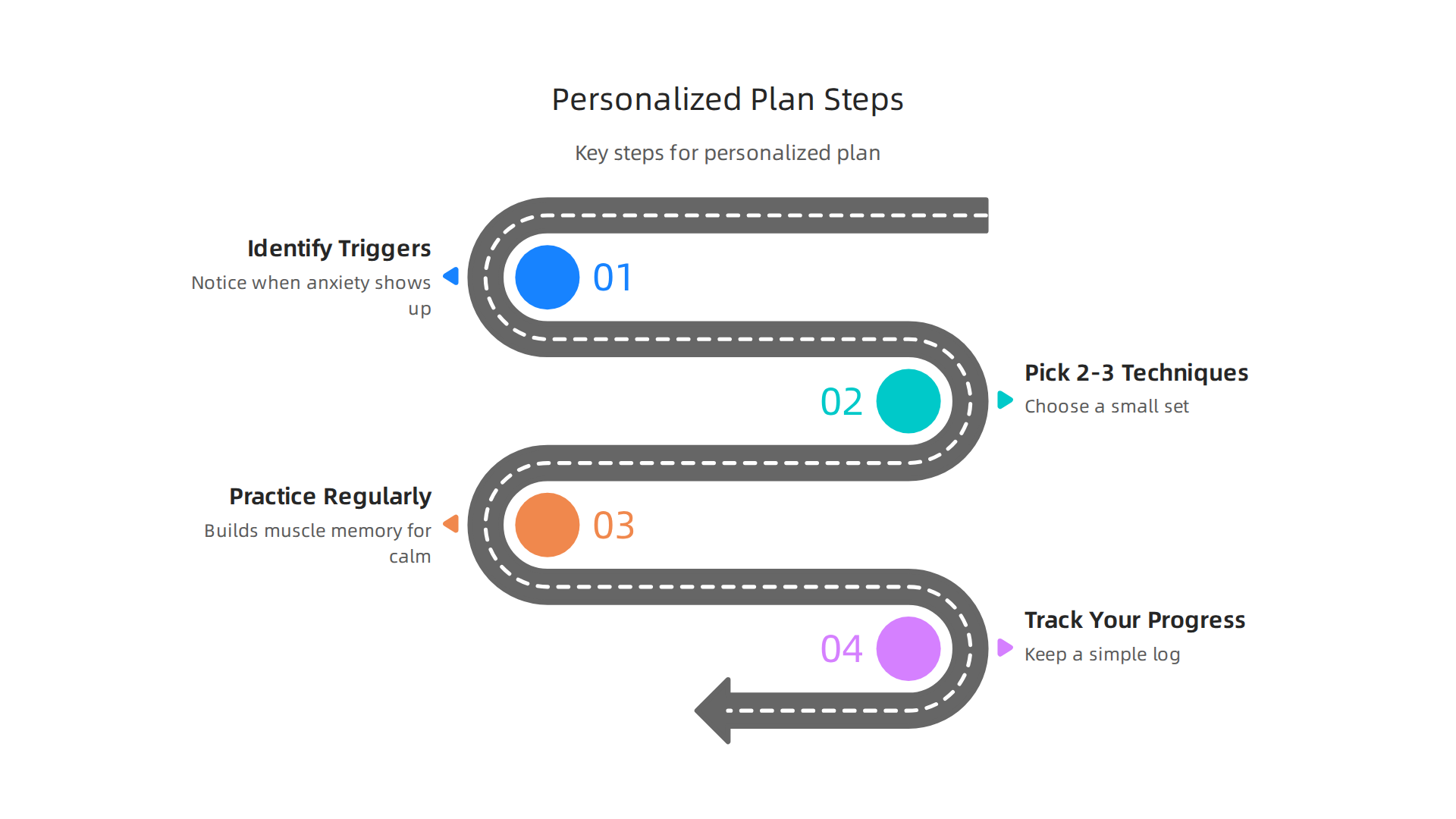
Step 1: Identify Your Personal Triggers
Start by noticing when performance anxiety shows up. Is it right before you speak in a meeting? During a test? When you step onto a stage? Write down the specific situations. Also note the physical feelings and thoughts that come with them. For example, you might notice your heart races and you think “I am going to blank out.” Getting this clear helps you choose the right techniques.
Step 2: Pick 2-3 Techniques That Work for You
You do not need to use every strategy at once. Choose a small set that targets your biggest struggles. If your body gets tense, pick breathing exercises and progressive muscle relaxation. If your mind spirals into negative thoughts, choose cognitive reframing and visualization. Keep it simple so you can practice without feeling overwhelmed. Research shows that psychological interventions focusing on cognitive reappraisal and self-talk regulation have the most promising results for performance anxiety. The systematic review on the effects of psychological interventions on performance anxiety confirms that these techniques work best when used consistently.
Step 3: Practice Regularly, Even When You Are Calm
This is the most important part. You cannot learn a skill under pressure. Practice your chosen techniques for a few minutes every day, even when you have no performance coming up. This builds muscle memory. When the big moment arrives, your body and mind already know what to do. The comprehensive guide to managing performance anxiety recommends daily practice of relaxation skills so they become automatic.
Step 4: Track Your Progress
Keep a simple log. After each practice or performance, note down: What technique did you use? How did you feel before and after? What worked well? What could you improve? Tracking helps you see patterns and adjust your plan over time. It also shows you how far you have come, which builds confidence.
Why Consistency and Gradual Exposure Matter
Your plan will not work if you only use it once. Consistency trains your brain to stay calm longer. Gradual exposure means you start with easier situations and work up to harder ones. For example, if public speaking scares you, first practice alone in your room. Then practice in front of one friend. Then record yourself. Then speak to a small group. Each success tells your brain “I can handle this.”
Example Plan: A Student Preparing for a Speech
Here is what an 8-day plan might look like for a college student with a class presentation on Friday:
- Monday through Wednesday: Practice the 4-7-8 breathing technique for 3 minutes each morning. Write down one anxious thought and reframe it into a balanced statement each evening. Use the anxiety management step-by-step strategies guide to stay on track.
- Thursday: Practice the full speech in front of a roommate. Use grounding techniques right before starting. Note how you feel.
- Friday (presentation day): Do a 5-minute mindfulness body scan before class. Use positive self-talk as you walk to the front. Focus on friendly faces during the talk.
This plan uses small, repeatable actions. It does not expect perfection, just steady progress.
Start Building Your Plan Today
You already have the skills. Now customize them. Keep your plan simple, practice daily, and track what works. Over time, performance anxiety will feel more like manageable energy than overwhelming fear. If you want to understand your anxious thoughts on a deeper level, take a moment to move past the definition and use a research lens to see what your anxiety is really saying. Use the tool at Move Past the Definition to gain clarity and build inner strength.
When to Seek Professional Help
Your personalized plan and daily practice can take you far. But there comes a point where self-help is not enough. Recognizing that moment is a sign of strength, not failure.

Signs That Self-Help Is Not Enough
Performance anxiety becomes a bigger problem when it starts to control your choices. You might notice you are:
- Avoiding important opportunities. You turn down a promotion, skip a class presentation, or cancel a date because the fear feels too big.
- Struggling in your daily life. Anxiety interferes with your work, school performance, or close relationships.
- Developing physical symptoms. You get chronic headaches, stomach issues, or a racing heart that does not go away.
- Using alcohol or other substances to get through anxious moments.
- Finding that self-help only gives temporary relief. The anxiety keeps coming back or gets worse over time.
According to the guide on performance anxiety and why it happens, another clear signal is when anxiety feels so intense that you cannot even use the coping techniques you learned. That is when professional support can make a real difference.
Therapy Options That Work
The good news is that several evidence-based treatments can help you overcome performance anxiety.
Cognitive Behavioral Therapy (CBT) is one of the most effective approaches. It helps you identify the negative thought patterns that fuel your anxiety and replace them with more balanced thinking. CBT also teaches you coping skills you can use in the moment.
Exposure therapy works by gradually facing the situations you fear in a controlled, safe way. You start small and build up. Each success trains your brain that you can handle the challenge.
Mindfulness-based interventions help you stay in the present moment instead of worrying about what could go wrong. They reduce the anticipatory fear that often drives performance anxiety.
In some cases, a doctor might recommend medication for short-term relief. Beta-blockers, for example, can lower your heart rate and block the physical effects of adrenaline. The comprehensive guide to managing performance anxiety notes that medication works best when combined with therapy and lifestyle changes, not as a standalone fix.
How to Find a Qualified Professional
Start with your primary care doctor. They can rule out any medical conditions and give you a referral. You can also search for a licensed therapist, psychologist, or psychiatrist who specializes in anxiety disorders.
Look for professionals trained in CBT or exposure therapy. Ask about their experience with performance anxiety specifically. Many therapists now offer online sessions, which makes it easier to find someone who fits your needs.
If you are not sure where to begin, reading about when to seek stress management therapy can help you understand what to expect from the first session.
You Do Not Have to Wait Until It Gets Worse
The longer performance anxiety persists, the more ingrained the pattern becomes. Early intervention usually leads to faster improvement. Most people notice meaningful progress within a few weeks or months of starting therapy.
Asking for help is not a sign of weakness. It is a smart step toward taking back control of your life.
Summary
This article explains performance anxiety—what it is, how it differs from general social anxiety, and why it shows up in situations like public speaking, tests, auditions, or interviews. It describes the typical physical, cognitive, and behavioral symptoms and maps the self-reinforcing cycle that turns normal nerves into avoidant patterns. The guide then gives practical, evidence-based tools you can use immediately (breathing, grounding, and visualization) and skills to practice long term (cognitive reframing, gradual exposure, and routine rehearsal). It walks you through building a simple, personalized plan—identify triggers, pick 2–3 techniques, practice daily, and track results—and explains when self-help is enough versus when to seek professional care. Readers finish able to interrupt panic in the moment, reframe catastrophic thinking, and steadily build confidence so performance situations feel manageable rather than overwhelming.